
 |
Key Points
|
A research proposal outlines a proposed research project, detailing its purpose, significance, and methodology. The proposal, sometimes called a brief, outlines the researcher’s plan for conducting research to answer a particular research question.
Typically, a research proposal includes an introduction or problem statement that outlines the focus of the study, a clear research question, a rationale explaining the topic and its significance, a literature review identifying gaps in the current literature and a detailed methodology describing the approach and tools to be used.
How do I plan it?

How do I structure it?

Common Headings
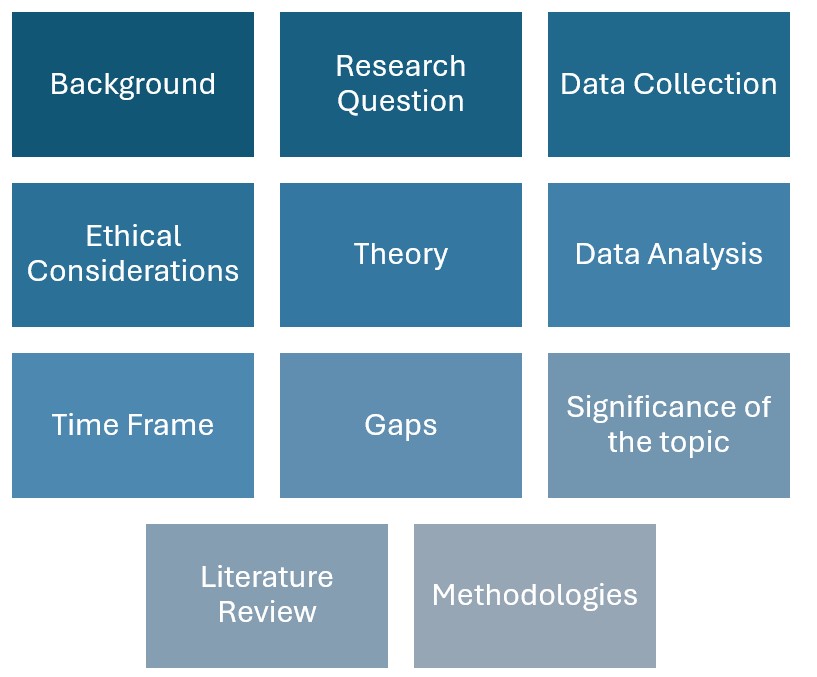
* Note these are abridged versions of typical paragraphs
|
Significance of the Research This research will enhance the understanding of how telehealth implementation can improve access to healthcare services for residents in regional Queensland. Identifying specific strategies for integrating telehealth effectively in these areas could inform policies and practices aimed at addressing healthcare disparities in rural and remote communities. Expanding the use of telehealth in regional Queensland could have broader impacts by improving health outcomes, reducing healthcare costs, and enhancing the overall efficiency of the healthcare system, a critical sector in supporting Australia’s economic and social well-being (Department of the Prime Minister and Cabinet, 2023).
|
Introduce the importance of the research to the participants. Identify how the research will help participants.
Identify broader impacts to other stakeholders.
|
|
Study Participants and Sampling In-depth and semi-structured interviews will be conducted with 20 healthcare professionals and administrators working with nursing home facilities in regional Queensland. Qualitative data analysis will be performed using the thematic analysis method. To participate, individuals must have at least six months of experience in implementing or using telehealth services in regional healthcare settings. Participants will be chosen through targeted sampling to ensure a diverse group with varying levels of expertise and roles in telehealth implementation. Healthcare professionals who have not actively participated in telehealth implementation or usage within the past year will be excluded from the study, as their insights may not reflect current practices, technologies, or challenges associated with telehealth in regional Queensland.
|
Introduce who the participants are and how many you will recruit. Include any important background information and the selection process.
Include any exclusion criteria.
|
|
Literature Review |
|
Much of the current literature on X pays particular attention to … Author: reported / identified / showed that /demonstrated that … |
|
Research Design and Methods |
|
This study will adopt a… |
|
Significance of the Research |
|
The findings of this study could inform policies aimed at improving... Understanding [topic] is crucial for addressing challenges related to... By exploring [topic], this study could provide evidence to support... |
|
Communication of Results |
|
The results of this study will be shared through… Findings will be presented at relevant … Results will be disseminated through… A detailed report summarizing the key outcomes will be provided to… |
Why do you need to include evidence?
When planning a research project, it is important to show that your choice of methods is supported by evidence. Using evidence from academic sources demonstrates that your approach is not only personal preference but is also trusted and tested in the field. This strengthens your research by linking your plan to best practices and recommendations from other scholars. It also helps readers understand why your method is appropriate for answering your research question. By integrating evidence into your explanation, you make your research design more credible, reliable, and academically sound.
What does it look like?
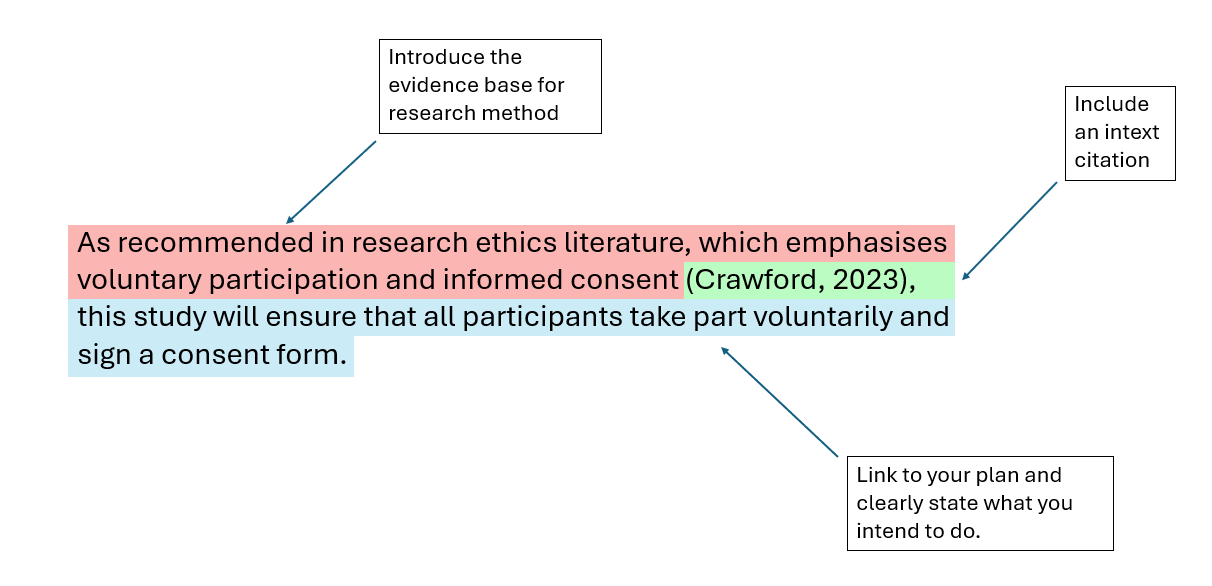
Introducing Evidence
“As recommended in research ethics literature…”
“In line with best practice for qualitative analysis…”
“Following established procedures…”
“Consistent with research guidelines…”
Linking to your study plan
Clearly describe what you will do in your research.
Use verbs like will ensure, will require, will analyse, will follow.
Example phrases:
“all participants will sign a consent form”
“semi-structured interview data will undergo thematic analysis and translation”

